Research foundation

Published methodology. Live evidence. Active research.

Canon Pack Lite (CP-Lite) is the commercial implementation of the peer-reviewed Canon Pack methodology. This page collects the citations, the CP-Lite vs CP-Full distinction, the reference numbers from the live 9-book collection, and a downloadable publisher brief.

§ 01   Peer-reviewed methodology

Research foundation & publisher brief.

For publishers, literary estates, and rights holders

AI reading tools are already answering questions about your books — using their own defaults, not the author's intent.

We tested this across nine canonical texts. The same pattern appeared every time: philosophy becomes self-help, military doctrine becomes life coaching, theology becomes personal growth. The words are accurate. The register is wrong.

The Canon Pack is a structured governance layer that encodes an author's actual intellectual framework into a reading companion before any reader asks a question. The result: every reader receives an interpretation consistent with your editorial standards — not because they prompted correctly, but because the interpretation was built upstream.

The full methodology, four documented case studies (Meditations, The Art of War, The Confessions, Walden & Civil Disobedience), before/after response comparisons, and a four-week, no-cost pilot offer for one of your titles are in the briefing below.

Download: The Interpretation Gap — A Briefing for Publishers PDF, 13 pages, ~150 KB

Download: Technical Paper on comparison of CP-Lite and CP-Full Governance PDF, 12 pages, ~420 KB

§ 02   Two product variants

CP-Lite vs CP-Full — the architectural distinction.

Two product variants of the Canon Pack methodology, mapped to two buyer problems. CPLite is the governance-first, portable layer designed for scalable backlist deployment. CPFull adds chunking, vectorization, and retrieval over the structured source text for higher-fidelity representation of premium or high-stakes titles.

DimensionCPLiteCPFull
Core purposePortable governance layer for AI-mediated interactionHigher-fidelity canonical representation of a work
Text handlingReviewed structure, concepts, claims, and behavior settings shape responsesFuller text representation; chunking, vectorization, retrieval plus governance
Cost profileLower; faster onboarding; lighter infrastructureHigher cost, heavier infrastructure
Speed to deployFasterSlower
Best forPublisher pilots, embeddable deployments, broad backlistPremium titles, high-stakes nonfiction, educational use
PortabilityHigh — easier to embed/license across platformsLower — more infrastructure-dependent
Where to learn moreThis pageInteractive demo + preprint

§ 03   Reference numbers

CP-Lite live-shelf conformity, indicative.

Conformity scored against a fixed rubric on the live 9-book collection (forbidden-phrase suppression, chapter/scene citation rate, closing-question text-grounding). Numbers are indicative pending publication of the second preprint. Methodology and source measurement under documentation review.

~95%

Mean conformity on questions with a matched seeded exemplar.

~85%

Mean conformity across the live 9-book collection, averaged over matched and novel probes.

~70%

Baseline from the same stack with exemplars and per-book governance disabled.

§ 04   The control stack

How the governance layer sits on the model.

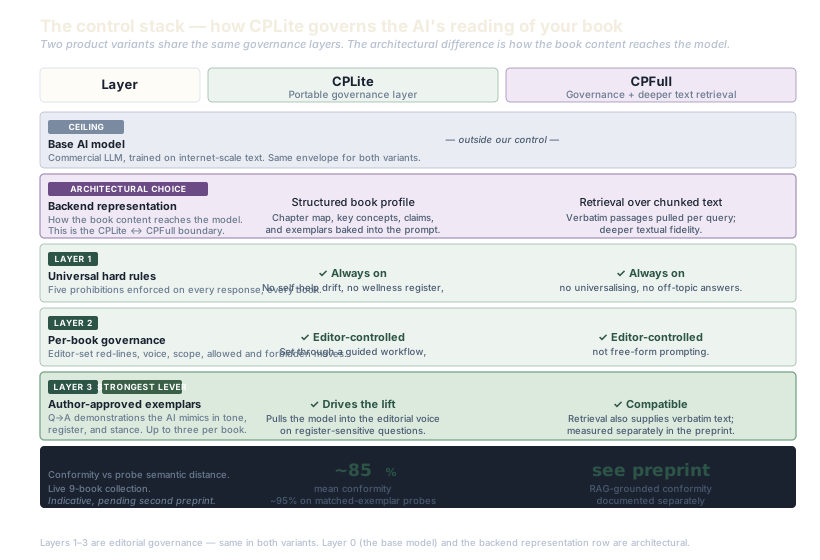
Three governance layers sit on top of the base AI model, regardless of which architectural variant is in use. The CPLite ↔ CPFull boundary is the backend representation row — how the book content reaches the model. The governance layers are shared.

The CPLite control stack: base AI model (outside our control) at top, backend representation row marking the CPLite vs CPFull architectural boundary, then three governance layers (universal hard rules, per-book governance, author-approved exemplars) shared by both variants, ending in the empirical conformity outcomes.
Simplified for publisher audiences. A more detailed engineering view (sampling parameters, character budgets, file references) is documented in the architecture spec accompanying the preprint.

Methodology in production.

The framework is not a paper exercise. See the workflow run on a real book, or move directly to engagement.

See it in action → Pricing & engagement